
Structure and function of plants: a new vision
Everyone knows that plants produce most of the oxygen we breathe and provide food for animals and humans. Many people know that plants produce energy through photosynthesis, the process by which light energy is converted into chemical energy. Some people think that plants are a renewable energy source with great potential. In short, they would like to know, but do not know, whether energy can be obtained from plants.
The study of the architecture of plant biomass and the mechanisms that regulate its development, as we know them, trap us in the coils of knowledge whose limits even quantum computers cannot overcome. Accelerating computing power is not enough.
The magnetic halo structure of the plant
It is important to distinguish the plant's halo structure from its traditionally recognised parts or components (trunk, branches, roots, leaves, etc.), i.e. its physical structure.
More correctly, we define the plant's magnetic halo structure as the source of its cellular, anatomical, physiological and biochemical organisation. We could include it in the subatomic structure of matter because the nature of the source is energetic and its expression is the signal.
The plant's halo magnetic field does not only concern the ionic field because, like all forms of life, it captures cosmic rays in the form of extrasensory frequencies of varying degrees, i.e. extrasystemic energies in perpetual motion that exceed the speed of light, interacting in Space–Time–Flow (cf. A. Mendini).
The threefold concept of Space-Time-Flow concerns the unfolding of the life program in general, which takes place within a specific space and a specific time, and includes the “access to future space and its occupation”, understood as a projection of being. Flow, referring to the plant's halo field, concerns the ability to process vital potential and determines the unfolding of every function, such as the formation of leaves and fruits, and the plant's capacity for self-defence and self-management.
To understand the structure and function of plants, we must therefore focus first and foremost on the plant's primary programming.
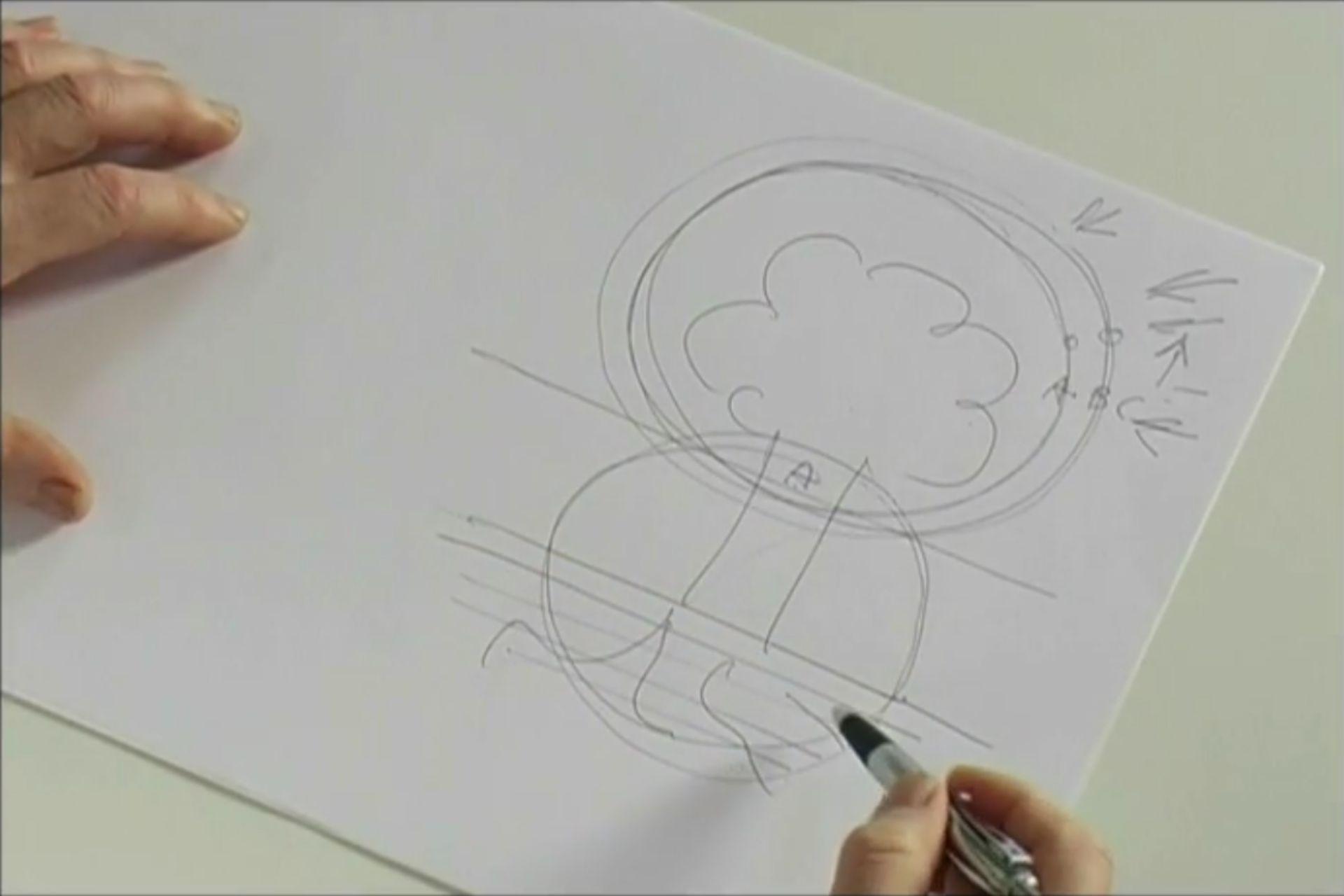
The plant’s primary programming
Back in 2005, in the video ‘Infiniti perché’ (Infinite Whys), researcher Alessandro Mendini outlined the programmatic field of the plant, describing its magnetic halo structure.
Over the years, through his teachings on the fields in which Nature expresses itself, on the messages transmitted by molecular structure, and on the energetic transformations of plants, I have come to understand that the programme is the line of development of life, regulated by codes and energy flows. Plants have a programme, therefore their vital processes are controlled.
The plant is an evolutionary being in that it interacts with basic universal intelligence.
As described in the video “The Technology of Energy: 20 Years Later”, planetary foundational intelligence is a form of natural energy. It can be transformed into all types of energy, into all forms - both visible and invisible - and can generate every kind of programme for life.
Thus, the architect of life is cosmic energy in perpetual communication, and the transduction of the signal within the plant - that is, the process by which information is transferred from the extracellular messenger to cellular receptors - is determined by the plant’s magnetic halo structure, according to the specific programme involved. This form of triangulation between signal emanation, reception, and programming constitutes the vital impulse transmitted magnetically to the cell membrane. It is a variable energetic field that charges inert structure and subsequently acts upon the biomass. In the same way, every cellular, anatomical, physiological, and biochemical activity is always regulated on the magnetic plane.
Therefore, the greater the strength of the plant’s magnetic halo field, the greater its capacity to respond - for example, to a cold wave or to the infection of a bacterial cell. Conversely, the lower the plant’s vital charge, the greater the damage it will suffer. This applies to the defence programme. With regard to the programme of natural plant nutrition, activated through the process of chlorophyll photosynthesis, we may state that the greater the energy available, the greater the plant’s photosynthetic capacity - that is, its ability to transform substances into the nourishment necessary for life and growth.

The functions of the magnetic halo structure of plants
Darwin already spoke of the ability of plants to adapt to their environment towards the end of the nineteenth century. Today, however, as plants are increasingly unable to produce as a result of environmental degradation, professionals in the field hypothesise that plants are intelligent, conscious, and neurobiologically organised. In truth, ever since the word was taken away from Mother Nature and attributed to science in the form of knowledge, these rational yet confused visions have only intensified.
To those who argue - by virtue of human decision-making power - that plants do not need us, but that we need plants because we have coexisted with them for thousands of years, it is worth asking for what reason they are part of creation at all.
I believe it is because everything that exists serves a purpose in some way.
Is it truly impossible to scientifically support the concept of a “cellular basis of consciousness”? Or is it perhaps time to reunite what science has divided?
A suggestion has come to us from quantum physics applied to biological processes. But even earlier - and we might cite William Crookes (1895) - there were those who identified, within the atom and the subatomic realm, the capacity to choose one’s own path. I once again mention, because he stands at the most advanced frontier of scientific research, the Italian genius Alessandro Mendini, who put into practice the knowledge of evolved civilisations by making higher-level energies available (cf. the Kardašëv scale, a method for classifying civilisations according to their technological level based on the amount of energy available to them).
This is the meaning of the COSMIC 18F solar energy multiplier, located within the AXS M31 scientific–technological park, where the energy reception system of the collectors is based on crystals. Here, research has demonstrated that:
- plants grow by capturing energies and transforming them into biomass;
- minerals expand the plant’s halo capacity;
- BioAksxter® inorganic compounds with magnetic formulation nourish and fertilise the soil, making it the optimal nourishment for plant life and for all living structures that depend on it, including the human species.
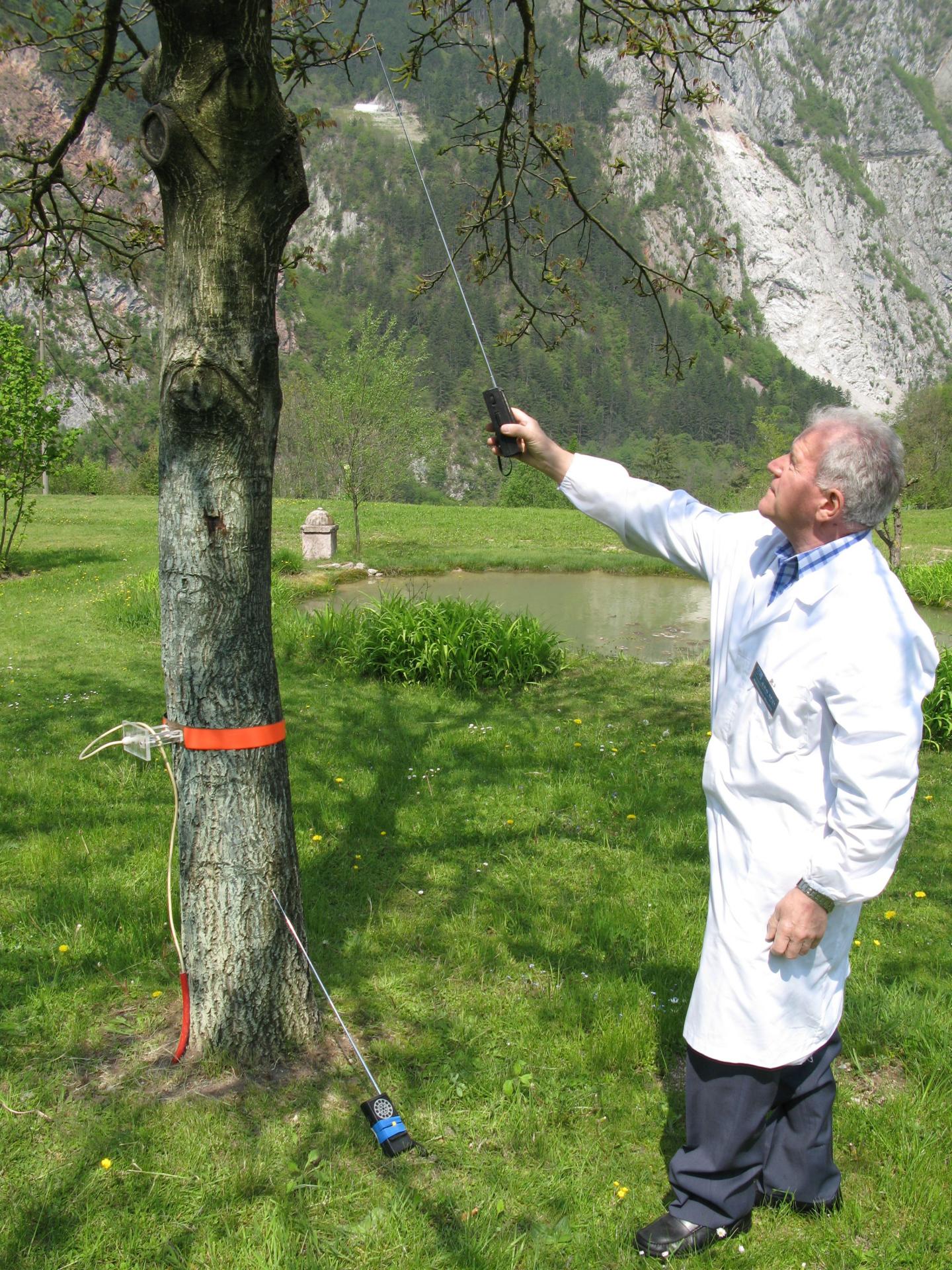
07/05/2008 – Researcher Alessandro Mendini / Measurement of the plant’s halo capacity – AXS M31 Scientific and Technological Park
How plants communicate
When I was a child, I used to talk to plants. I wrote little notes and placed them in their hollow stems. Then I would go back to look at them, searching for answers. More than how, I was interested in what plants communicate.
Very little is known about the system of electrical signals through which plants communicate with one another and with their environment. Discussion is usually limited to Mimosa pudica and carnivorous plants, introducing arguments related to plant neurobiology or to the so-called “plant action potential,” to which this function has been attributed. Debate continues, with the existence of a “consciousness” in plant organisms considered scientifically unsustainable - understood as awareness of environmental changes, experiences, and sensations - its meaning dismissed on the basis of an apparent immobility.
Yet it is possible to investigate all this and obtain answers precisely by crossing the boundaries of scientific knowledge and its dogmatic assertions. We would come to understand that the primary programming of plants is a clearly defined and unified plan within the cosmic process.
More than one hundred years have passed since Frederick Soddy’s discovery of isotopes. The Nobel Prize in Chemistry (1921) contributed to the theory of natural atomic transmutation of matter, according to which elements spontaneously transform into other elements. And yet, even today, agronomists ignore the continuous flow of energy upon which life depends and, instead of warning farmers about the potentially devastating effects of chemistry, they encourage its accumulation by prescribing the addition of disparate substances to the soil that plants do not absorb. This is anything but agronomic science.
Thus, the energies that regulate planetary life are a set of magnetic flows programmed by foundational intelligence. The plant receives commands from its magnetic halo structure. The cell membrane captures the magnetic imprint of the message generated by the halo structure of the electron that sustains the atom. The connection builds mass. These are biological nano-programmes that construct life. This goes far beyond plant physiology.
Therefore, to those agronomists I would say: in order to manage the complexity of agrarian systems and find answers related to crop productivity, one must not forget that nature can be commanded only by obeying it, and that nature is an open book - but it must be read all the way through.


